Dubai Astronomy Group
The stars that guided
a civilisation
Long before telescopes, Arab astronomers mapped the heavens with breathtaking precision. Their legacy lives in every star name, every navigation chart, and in a tradition still alive across the Arabian Peninsula today.
The golden age of Arabian astronomy
8th – 14th century CE
From the 8th century onwards, the Islamic world experienced a remarkable flowering of scientific achievement. Caliphs funded observatories and centres of learning. Scholars translated the works of the ancient Greeks, expanded upon them, and made major advances in astronomy, mathematics, medicine, and optics. At the heart of this intellectual movement was Bayt al-Hikma — Baghdad's House of Wisdom — a major centre for translation and scholarship. The knowledge preserved and developed there would later help shape the European Renaissance.
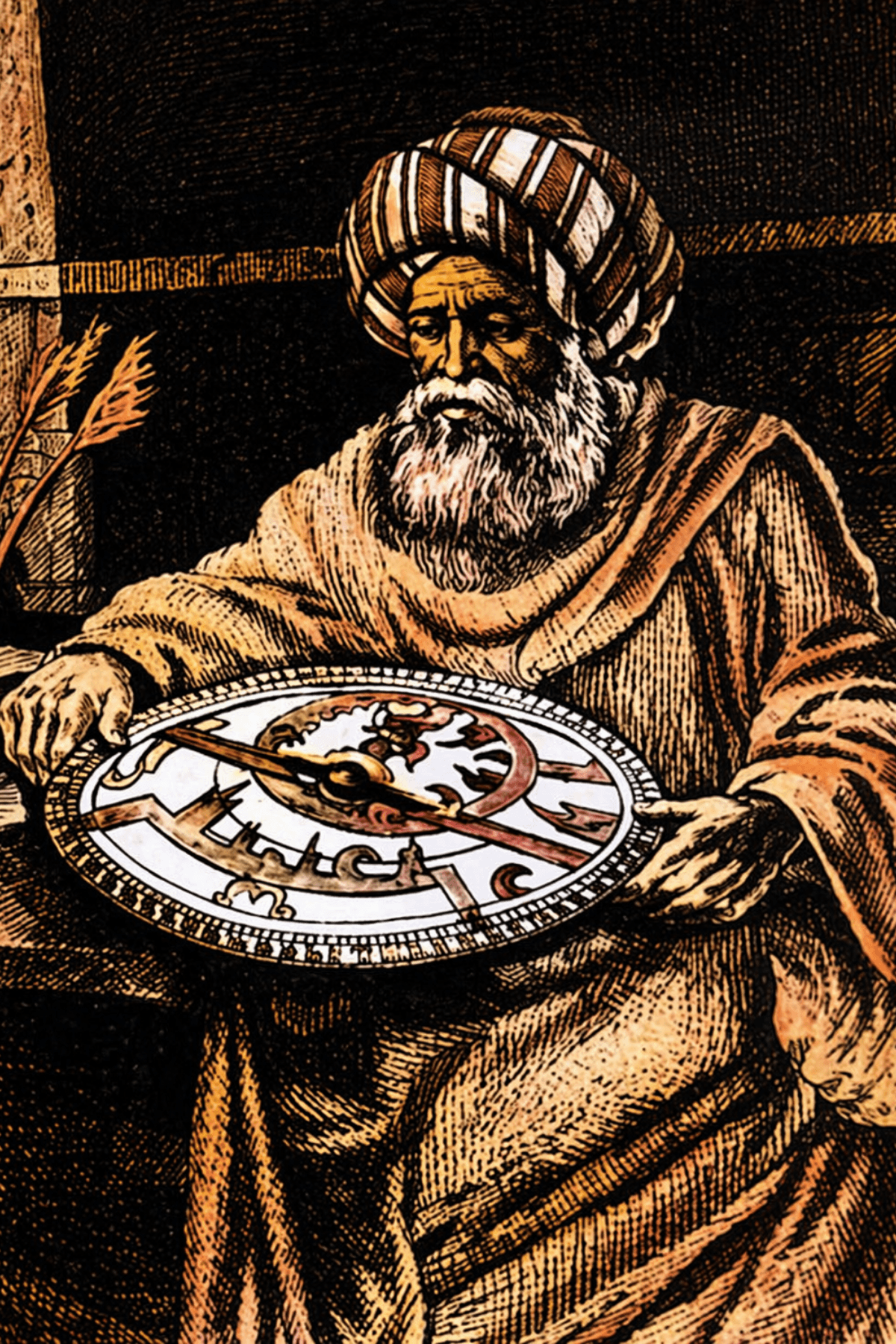
Al-Battani
The Arab Ptolemy · 858 – 929 CE
Muhammad ibn Jābir al-Battani spent decades at his observatory in Raqqa making painstaking naked-eye measurements. He refined the solar year to a precision that was remarkably accurate for its time, calculated the inclination of Earth's axis, and corrected dozens of errors in Ptolemy's work. Copernicus, Tycho Brahe, and Kepler all cited him directly. The Moon crater Albategnius is named in his honour.
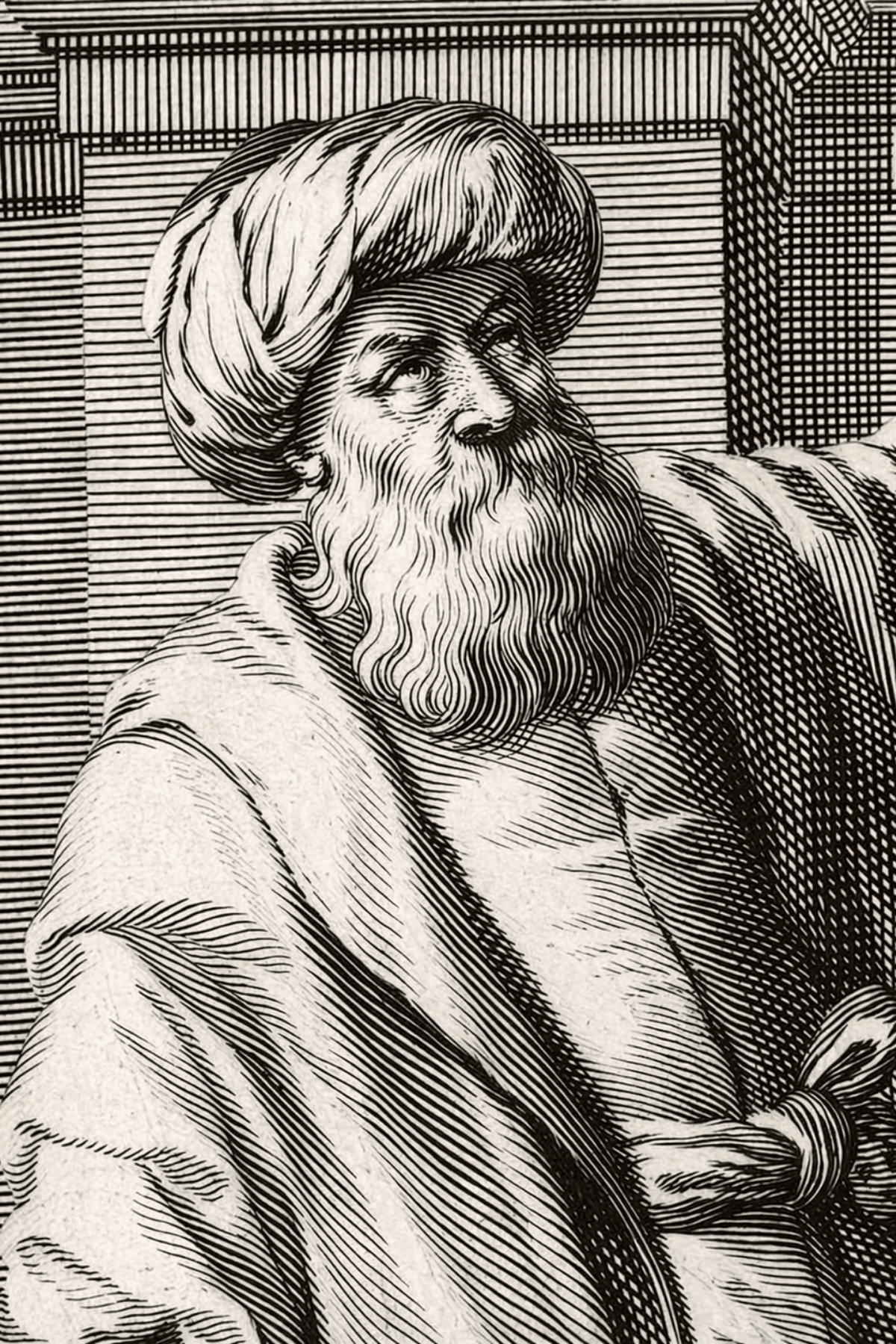
Ibn al-Haytham
Father of optics · 965 – 1040 CE · Basra & Cairo
Ibn al-Haytham made lasting contributions to both astronomy and optics. In astronomy, he challenged the Ptolemaic model of the cosmos in his Doubts on Ptolemy, studied the Moon's light as sunlight reflected off its surface, and investigated atmospheric refraction — the bending of starlight as it passes through Earth's atmosphere, which affects the apparent position of every object near the horizon. His Kitāb al-Manāẓir (Book of Optics) overturned a millennium of Greek theory by correctly explaining that light enters the eye, not the reverse. Crucially, he insisted that every hypothesis must be confirmed through repeatable experiment and mathematical reasoning — a rigour that has led many historians to regard him as the world's first scientist.
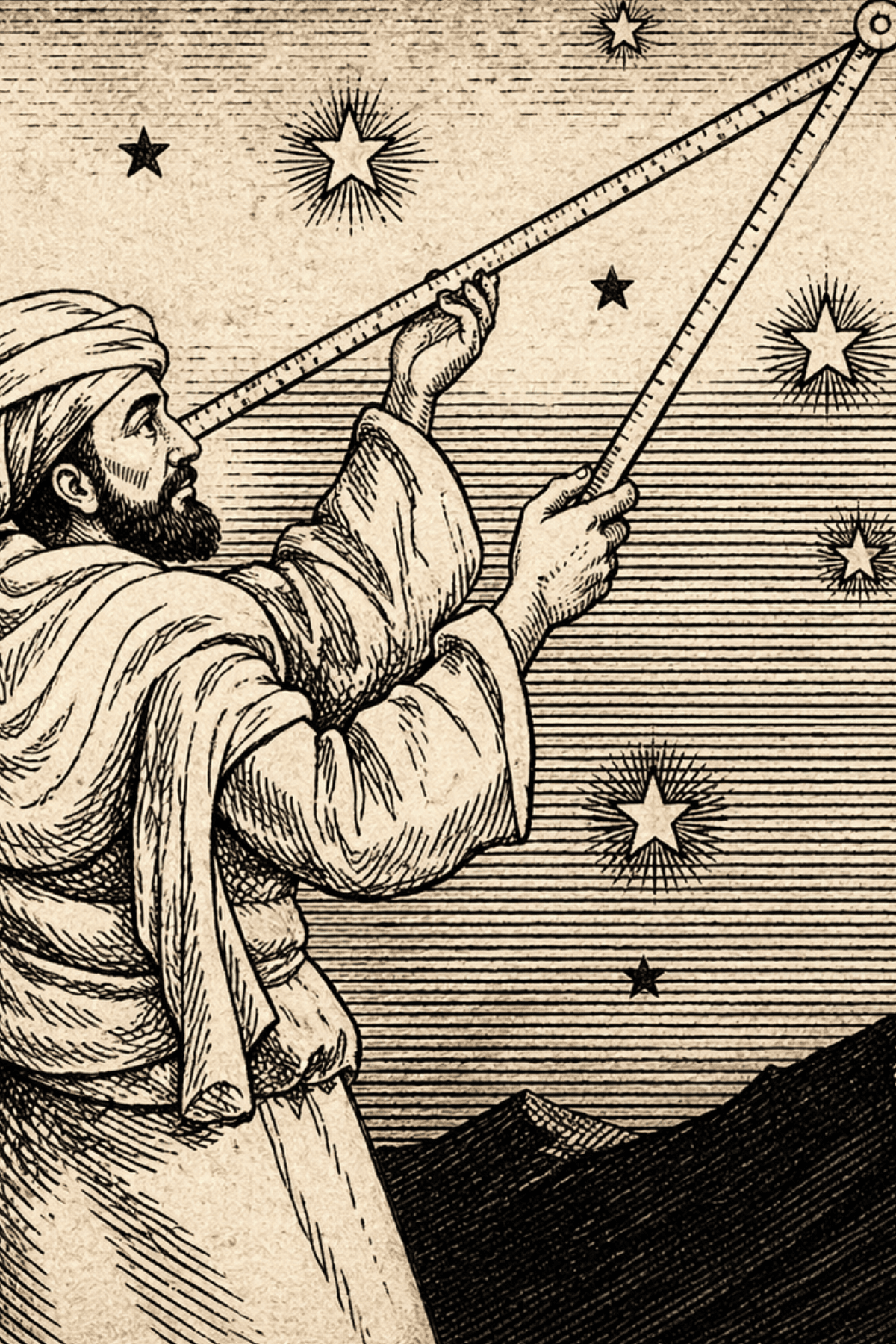
Abd al-Rahman al-Sufi
The keeper of the fixed stars · 903 – 986 CE
Al-Sufi's Kitāb Ṣuwar al-Kawākib (Book of Fixed Stars, 964 CE) catalogued 1,025 stars with positions, magnitudes, and illustrations of each constellation. Crucially, it contains the first ever recorded observation of the Andromeda Galaxy, described as a "little cloud." Al-Sufi preserved Arabic star names alongside Ptolemy's Greek ones — ensuring the Arab naming tradition survived into the modern age.
The astrolabe
The smartphone of the medieval world
Arab astronomers inherited the astrolabe from the Greeks and transformed it into the most sophisticated scientific instrument of the medieval era. With one astrolabe, a scholar could determine the time, find Mecca, calculate building heights, predict sunrise and sunset, and navigate across oceans. Over 40 known uses were documented. Arab craftsmen produced astrolabes of extraordinary beauty — many survive in museums today.
← drag to rotate →
Manāzil al-Qamar
The 28 stations of the Moon
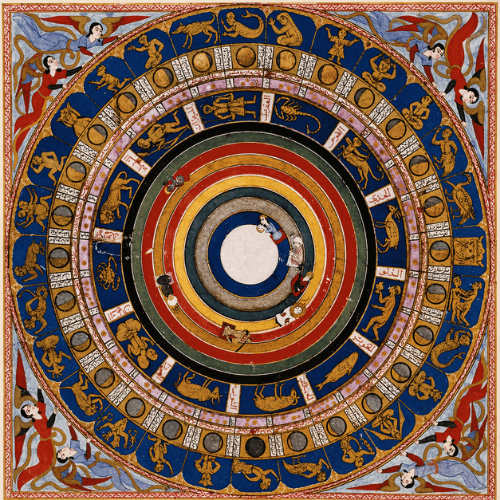
Arab astronomers divided the Moon's monthly path through the sky into 28 stations — the Manāzil al-Qamar. Each mansion was marked by a star or star group the Moon passed through on a given night. This system became a remarkably precise natural calendar: each mansion brought its own expected weather, winds, tides, and agricultural conditions. Bedouin tribes, sailors, and farmers across Arabia used the mansions to plan their entire year. The mansions are still referenced in traditional Gulf weather knowledge today.
Al-Duroor calendar
The star calendar of the Gulf
Al-Duroor is a traditional astronomical calendar of the Arabian Gulf — a living system shared across the Gulf states and passed down through generations of pearl divers, fishermen, and farmers from the UAE to Oman, Qatar, and beyond. The calendar begins the moment Suhail (Canopus) first rises in the pre-dawn sky, signalling the breaking of the intense Gulf heat. The year is divided into 10-day segments, each with its own name, weather prediction, and guidance for activities at sea and on land.
Suhail
Canopus — the star that governs the year
No star holds more cultural weight across the Arabian Peninsula than Suhail. The second-brightest star in the entire sky, it sits low on the southern horizon — visible from the UAE each year from late August onwards. For Emirati ancestors, Suhail's first appearance was a moment of profound relief: the brutal summer was breaking. Pearl divers would return from the sea. Farmers would begin preparing the land. The Duroor calendar resets on this single star. Its rise is still tracked by UAE communities today.
"Knowledge is pursued solely by man, and pursued for the sake of knowledge itself, because its acquisition is truly delightful."
— Al-Biruni, Kitāb al-Tafhīm (1029 CE)
The heritage of Arabian astronomy is not history — it is alive. In every star you name in Arabic, every tide predicted by Suhail's rise, every time the Duroor calendar guides a farmer or fisherman, this tradition breathes. Based here in the UAE, we carry a special responsibility: to know this sky as our ancestors knew it, and to share that knowledge with the world.
Explore our programs
Anything you'd like to add?
All fields optional