
Dubai Astronomy Group
Crescent Watch
Map
Methodology

How we predict the crescent

Whether the new crescent (hilal) can be seen depends on how far it is from the Sun, how high it sits after sunset, and how dark the sky has become. Here is the geometry, the method behind our map, and the three criteria you can choose from.

01Basics

The geometry of a sighting

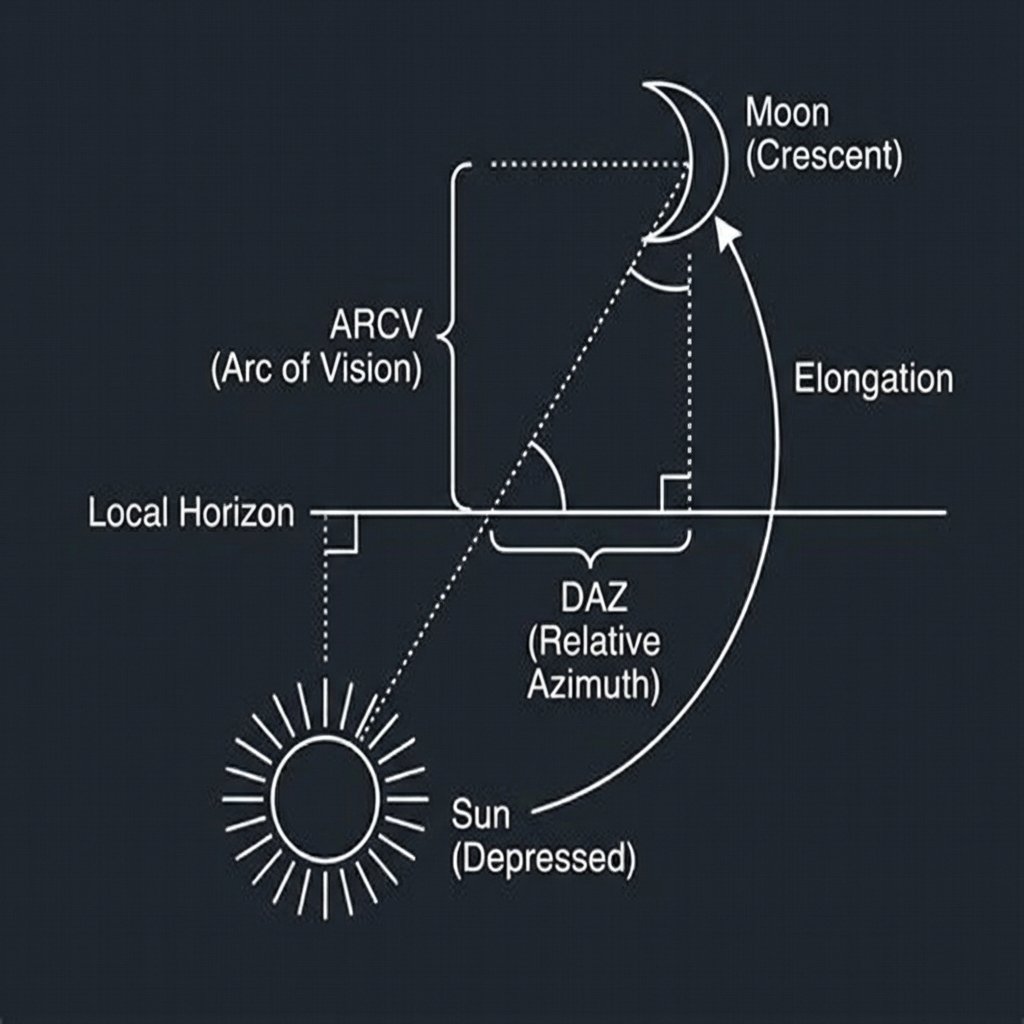
Every criterion is built from a handful of angles measured between the Sun, the Moon and the horizon just after sunset.

Diagram of the Sun below the horizon, the crescent Moon above it, and the arc of vision, elongation and relative azimuth between them
The Sun has set below the local horizon; the crescent sits above it, lit on the side facing the Sun.
ARCVArc of vision
Altitude difference between the Moon and the Sun. A larger ARCV puts the Moon higher in a darker sky.
ARCLArc of light (elongation)
Angular separation between the Sun and the Moon. Below ~7° the crescent breaks up (Danjon limit).
DAZRelative azimuth
Horizontal angle between the Moon and the Sun along the horizon.
WCrescent width
Thickness of the lit crescent in arcminutes: W = SD × (1 − cos ARCL).
LagMoonset − sunset
How long the Moon stays up after the Sun sets. Longer lag, darker sky.
TbBest time
Sunset + 4/9 × lag — the moment of best contrast between crescent and sky (Yallop).
02Our method

How the map works

The map runs entirely in your browser. For the evening you choose, it repeats these four steps across the whole globe.

  1. 1

    Sunset & moonset

    For every point on a 2° world grid, find the local sunset and the moonset that follows it. The gap is the lag.

  2. 2

    Is it possible at all?

    If sunset happens before the new moon (conjunction), or the Moon sets before the Sun, the crescent cannot be seen. These areas stay uncoloured.

  3. 3

    Evaluate at best time

    Otherwise compute the geometry at Tb = sunset + 4/9 × lag, using refraction-free positions of the Sun and Moon.

  4. 4

    Apply the criterion

    Odeh, Yallop or Istanbul turns that geometry into a visibility zone, which colours the map.

Sun and Moon positions come from the Astronomy Engine library (VSOP87 / ELP-based), accurate to well under an arcminute. Predictions assume a clear sky and a flat, unobstructed western horizon.

03Criteria

Three ways to judge visibility

Choose between these on the map. The colours below match the map legend.

Odeh (2006)

Default on the map

Mohammad Odeh · International Astronomical Center

Fitted to 737 crescent observations — more than twice Yallop’s dataset, including many made with binoculars and telescopes — so it separates naked-eye from optical-aid sightings well.

V = ARCV − (7.1651 − 6.3226 W + 0.7319 W² − 0.1018 W³)
Topocentric ARCV and crescent width W (arcminutes), evaluated at best time.
Odeh (2006), Experimental Astronomy — PDF
Zones
  • V ≥ 5.65Visible to the naked eye
  • 2 ≤ V < 5.65Visible with optical aid; may be seen with the naked eye
  • −0.96 ≤ V < 2Visible with optical aid only
  • V < −0.96Not visible, even with optical aid

Yallop (1997)

Classic reference

B. D. Yallop · HM Nautical Almanac Office

The long-standing standard, fitted to 295 historical sightings. Its six classes give a conservative, well-tested prediction.

q = [ ARCV − (11.8371 − 6.3226 W′ + 0.7319 W′² − 0.1018 W′³) ] / 10
Geocentric ARCV with topocentric crescent width W′, evaluated at best time.
NAO Technical Note 69 — PDF
Zones
  • q > +0.216A — Easily visible to the naked eye
  • q > −0.014B — Visible in perfect conditions
  • q > −0.160C — May need optical aid to find the crescent
  • q > −0.232D — Optical aid needed
  • q > −0.293E — Not visible with a telescope
  • q ≤ −0.293F — Below the Danjon limit

Istanbul (1978)

Calendar rule

Istanbul conference on the Islamic calendar · reaffirmed 2016

A simple pass/fail rule checked at sunset. Easy to verify and used for calendar decisions, but it does not grade how easy the sighting will be.

Moon altitude ≥ 5° and elongation ≥ 8° (at sunset)
Topocentric, refraction-free values at local sunset.
Zones
  • Both metMeets the criterion
  • Either not metDoes not meet the criterion
04History

From rules of thumb to models

People have tried to predict the first crescent for thousands of years. Modern criteria refine these early rules.

1930s

The Danjon limit

André Danjon found that below an elongation of about 7° no crescent can be seen: the shadows of lunar mountains break the thin arc apart. Modern analyses put the limit near 6.4° with optical aid and 7.7° with the naked eye.

Babylonian & medieval

Rules of thumb

Early astronomers used simple thresholds — a Moon older than 24 hours, or setting 48 minutes after the Sun. They often worked, but failed in edge cases such as high-latitude summers, because they ignored how geometry and sky brightness combine.

05Compare

At a glance

CriterionApproachBest forOn the map
Odeh (2006)Empirical curve, 737 sightingsNaked eye vs optical aidYes · default
Yallop (1997)Empirical curve, 295 sightingsConservative planningYes
Istanbul (1978)Altitude + elongation thresholdCalendar pass/failYes
Özlem (2014)Physical contrast modelResearch, edge casesNo · reference
06Reading

Further reading

Özlem (2014)

Not used in the map

A physical model: instead of fitting a curve to past sightings, it computes the actual contrast between the crescent’s brightness and the twilight sky, including atmospheric extinction, minute by minute after sunset. It handles high latitudes and daytime sightings better, at the cost of more assumptions about the atmosphere.

Özlem (2014) — PDF

See it on the map

Pick an evening, switch between criteria and open the sky simulation for any place on Earth.

Open Crescent Watch